The Top 10 Things You Need To Know About The Cost Transparency Of PAT in Telford
In the UK There is a substantial variation in pricing for Portable Appliance Testing Services (PAT). Cost transparency is an important factor when choosing a reliable and competent provider. Unlike some regulated industries with fixed pricing the costs for PAT testing are determined by multiple factors, including the volume of equipment used as well as the complexity of testing, geographic area, and the provider's knowledge. Transparent pricing goes far beyond a simple per-item quote to include all possible ancillary charges, definitions of service levels, and long-term value considerations. For dutyholders operating under the Electricity at Work Regulations 1989 Understanding the full cost analysis is vital not only for budgeting purposes but also to ensure that pricing considerations do not compromise the integrity and conformity of the testing regime. A service provider that is clear about what's included in the cost estimate and what might be additional costs. They'll also explain how their pricing structure aligns to a risk-based approach that adheres to safety regulations regarding electrical equipment.
1. Per-Item Pricing vs. Fixed-Price Contract Models
PAT testing companies typically offer two pricing choices. The per-item price model charges the same amount for each appliance tested (e.g. £1.50-£3.50 per unit) which is affordable for companies with less appliances. Fixed-price models are a contract that quotes an annual fee to cover the entire service. This kind of arrangement is usually preferred by large companies with several assets since it provides budget-friendly certainty. A transparent provider will present two options to the customer and will recommend the most cost effective structure for their specific needs.
2. Price Tiers Based on Appliance Types and Risk Categories in Telford
The most reliable providers won't offer a flat price for every device. Pricing that is transparent is an indication of the different degrees of risk and the work involved with each type. The equipment that is the cheapest used in offices is usually basic (Class 2) IT equipment. Higher-risk, more complex, or difficult-to-access equipment (e.g., industrial equipment commercial catering equipment, medical equipment, or appliances that require dismantling) will cost more due to the additional time, expertise and risk that are that are involved. The quotation should clearly classify appliances and provide the appropriate pricing tiers.
3. In the price quoted is a breakdown of everything that it comprises in Telford
Transparency can be achieved by offering a breakdown of price. It must specify whether the quoted price includes the following physical inspection, electronic tests required, application of labels for passed or failing, a complete document with a written certificate of compliance, as well as a detailed asset statement. Most importantly, it must state whether or not the cost includes tax. Many seemingly cheap quotes exclude these essential elements, adding these as additional charges later, substantially increasing the cost.
4. Other and possible hidden charges in Telford
A transparent company will divulge the additional charges upfront. These include:
Call-out charges: A minimal fee for visiting a web site especially for websites with a small number of appliances. in Telford
The mileage charges apply to sites that are located at a distance of more than 100 kilometers from the base of the engineer. in Telford
Re-test fees are the costs to retest an appliance following its repair. in Telford
Charges for duplicate copies of certificates or reports. in Telford
Fees for out-of-hours The cost of testing that is performed outside normal business times.
The quote should include the possible extras and their costs, so that you don't have unanticipated invoices.
5. Prices for Repair and Remedial Work in Telford
Costs for repairing any faults that are discovered in the course of testing is an important area in which transparency is essential. The pricing list provided by the service provider should be clear and upfront for all common remedial measures such as plug replacement, replacing fuses, cable repairs and so on. The service provider should clearly explain how they obtain client approval prior to completing any paid repairs. Some service providers include a "first-line" repair (such as a replacement plug) in their prices for testing that should be explicitly made clear.
6. Cost-related implications of risk-based testing approaches in Telford
A modern and competent PAT service will not be based on an annual test, but more on an assessment of risk. A transparent provider will explain the consequences of this method regarding cost. They might recommend longer intervals between formal tests for low-risk equipment (e.g. office equipment with double insulation) and also visual inspections. This is an important cost-saving option in comparison to providers who insist on testing all their equipment every year. The price should reflect this customized and risk-based frequency.
7. Costs for Calibration and their Application
It is the obligation of the company to pay for the annual calibration carried out by UKAS accredited labs. A transparent service provider can prove that they have included the cost of calibrating their equipment in their quote and that it has been in fact calibrated. They should be willing to provide evidence of calibration upon the request of. A low price may indicate that the company is cutting corners in this vital quality assurance measure.
8. Expertise and qualifications are top of the line in Telford
The cost should reflect the technical expertise of the technician. If a service employs engineers with the City & Guilds2377 qualification and have a vast amount of experience as well as a solid understanding of IET Code of Practice they could charge a higher price when compared to a less skilled worker. Transparency here means the provider describing the benefits provided by their technicians' expertise, which contributes to a more robust and defensible results in compliance.
9. Discounts for volume and pricing for multiple websites in Telford
For companies with multiple Telfords or large numbers of appliances, transparent suppliers will offer a clear volume discount structure or a bespoke pricing structure for multi-site agreements. The quotation should include the discount and pricing for all Telfords. This will streamline procurement and will help reduce costs for larger clients.
10. Prices and Guaranteed Price Terms in Telford
The final element of transparency is the clearness of the terms used in the quote the quote itself. The contract must specify the validity of the quote (normally between 30-60 days) to safeguard clients from price increases after acceptance. It should state whether there is a price guarantee. If yes it should state whether the price quoted is per item rates or a fixed price which is guaranteed throughout the duration of the contract. This will prevent unpleasant surprises, and allow for accurate financial planning. View the recommended portable appliance testing in Telford for site examples.

Top 10 Tips For Regulation Compliance When Servicing Fire Extinguishers in Telford
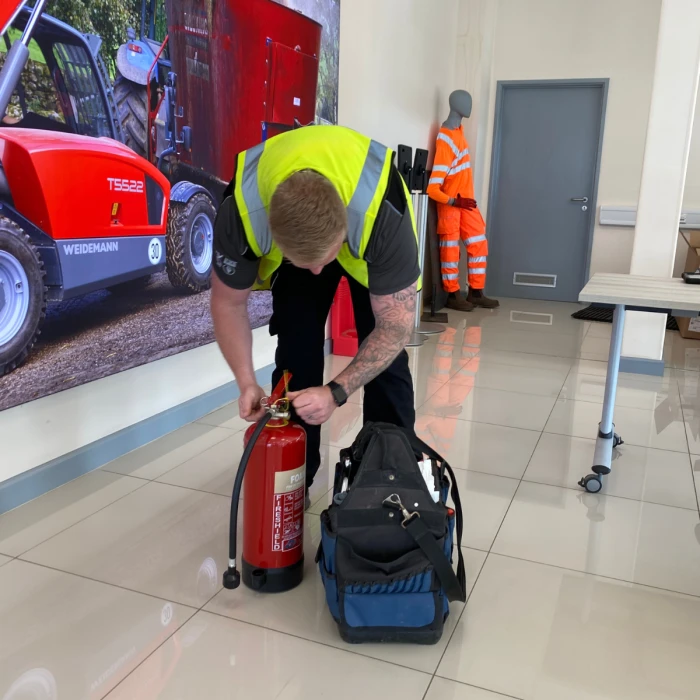
The UK regulatory framework that governs the use of fire extinguishers is a comprehensive, clear system. It is clearly outlined legal obligations and standards, and certification programs. Fire extinguisher regulations are more specific than some other safety regulations, which offer broad guidelines. They are backed up by specific technical standards and third-party certificate programmes that provide a well-defined path to compliance. This multi-layered approach places the primary responsibility for the maintenance of a building onto "the Responsible Person". The framework also offers standards for the demonstration of diligence. The understanding of this system, not just to maintain legal compliance but for ensuring the fire safety equipment will work in a way that is expected when emergencies occur, is vital.
1. The Regulatory Reform (Fire Safety) Order 2005 (FSO) in Telford
The legislation forms the basis of England and Wales the fire safety laws. Similar regulations are also in force in Scotland (Fire Scotland Act, 2006) and Northern Ireland. Article 17 specifies that all equipment used to fight fires should "be maintained with a reasonable routine of maintenance to maintain it in an efficient state, operating efficiently and in good working order." The Order assigns this responsibility to the "Responsible Person" (typically, the person who employs or owns the premises) who is legally responsible.
2. British Standard BS 5306-3 (2017)
The standard provides a structure for the FSO and details the requirements for maintaining and commissioning portable fire extinguishers. It outlines the kinds of services: basic service that includes an annual visual inspection, simple checks, an extended service that includes a discharge test and an internal examination once every five years for powder, water and foam extinguishers. It also provides overhaul, for CO2 and other gas extinguishers. According to the law, BS 5306-3 serves as the benchmark when demonstrating a "suitable maintenance program".
3. Third-Party Certificated Schemes in Telford
Even though it is not mandatory, the best method of demonstrating the due diligence of a company is to use a SP101 BAFE (British Appropriations for Fire Equipment) certified provider. This UKAS accredited certification scheme independently confirms a business's compliance with rigorous standards regarding the competence of technicians, their work quality and the quality of equipment. BAFE certification is recognized by the courts, fire authorities and insurance companies as proof a business is in compliance with FSO standards regarding maintenance.
4. Fire Risk Assessment: What is it? in Telford
The Fire Risk Assessments is the source of information that informs any decision related to fire safety, which includes those pertaining to maintenance of extinguishers. The Fire Risk Assessment (FRA) should specify the type, size and Telford of the firefighting equipment and its maintenance requirements. FRAs must be regularly reviewed, especially when circumstances change. Modifications must also be included in any scheduled servicing. These reviews are often aided by the reports of the servicing providers.
5. Documentation and Proof Requirements in Telford
Comprehensive documentation is critical in proving the compliance. After every service, the provider should provide a report that contains the company's information including engineer's details, service dates, list and description of services performed, equipment, and any faults that are identified. The reports must be available for inspection whenever required by law enforcement agencies including Fire and Rescue Services and insurance companies. Failure to provide adequate documentation could result in an enforcement action, even if the service was actually carried out.
6. The Enforcement Mechanisms of Penalties in Telford
Local Fire and Rescue Authorities carry conduct compliance audits and possess significant powers to enforce. For non-compliance with servicing requirements, they can issue: Alterations Notices (requiring changes to the fire safety measures) or Enforcement Notices (mandating specific changes within a timeframe) as well as, in more serious situations, Prohibition Notices (restricting or closing premises immediately). In serious cases, the courts can impose a maximum amount of penalties and jail terms of up to 2 years for any violation.
7. Insurance and its Implications in Telford
Commercial insurance policies typically require compliance with fire safety legislation as a condition of policy. Following a fire incident insurers are able to end insurance coverage if they find that the servicing documents aren't up to par or if services who do not comply with rules were utilized. Insurance assessors frequently require documentation on servicing when they process claims. Insurers might also need certain certification standards (like the BAFESP101) to be met in order to qualify for coverage.
8. Technical Competencies in Telford
The FSO specifies that the maintenance work should be completed by a "competent" person. While not legally defined, competence generally includes: formal training on BS 5306-3, manufacturer-specific equipment training, practical experience, and understanding of relevant regulations. Third-party programs like BAFE SP101 give the best assurance of the proficiency of technicians through regular assessment and audits.
9. Environmental Compliance (Duty Of Care) in Telford
Environmental law, and in particular the Environmental Protection Act of 1990, governs how to dispose of waste. Service providers must be registered as waste haulers and must provide Waste Transfer Notes when disposing of equipment. Responsible people must make sure that the service provider they select adheres to all laws and regulations. They are ultimately responsible for the disposal of their waste. They could be fined for not doing the right thing.
10. The frequency and scope of service requirements in Telford
The frequency of services is mandated in BS 536-3. For example, all extinguishers must receive an annual basic service, while water, foam and powder extinguishers require extended services every five years. CO2 units are required to undergo a complete overhaul every ten-years. Moreover, the Responsible Person is responsible for ensuring that monthly visual checks are conducted by staff (often). These inspections should be performed to detect obvious problems such as the loss, obstruction, or damage of pressure. The combination of professional servicing and user inspections creates an efficient maintenance program. Check out the top Telford fire extinguisher maintenance for blog examples.